

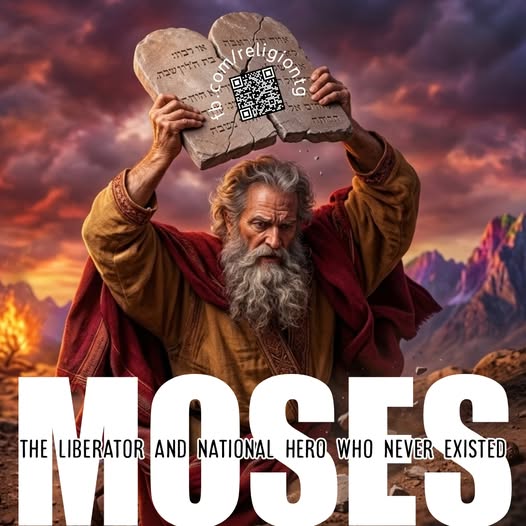

Let’s be precise: the absence of evidence is not always evidence of absence. But when a figure is described as confronting the greatest empire of the Late Bronze Age, unleashing plagues, leading a mass migration, and receiving laws from a deity atop a mountain, the total absence of corroboration becomes less a gap and more an abyss.
By Religion: The Good, the Bad, and the Ugly
1. Egypt Remembers Everything—Except Moses
Ancient Egypt was not shy about record-keeping. Pharaohs commemorated victories, building projects, grain distributions, and even minor administrative matters in inscriptions, papyri, and monumental art. Yet for all its verbosity, Egypt says nothing about Moses. No record of a Hebrew prince raised in the royal court. No mention of plagues devastating the land. No note of a slave population staging a dramatic exit.
This silence is not trivial. Egyptian records do mention foreign groups (such as the Semitic Hyksos), labor forces, and occasional unrest. If even a fraction of the Exodus narrative were historical—especially events as catastrophic as the plagues or the drowning of an army—it would be astonishing for Egypt to omit it entirely.
So the question becomes unavoidable:
How does the most dramatic national catastrophe in Egyptian history leave no Egyptian memory?
2. Archaeology and the Empty Desert
The Exodus story describes hundreds of thousands—sometimes interpreted as millions—wandering the Sinai desert for forty years. Archaeology, inconveniently, has surveyed this region extensively. The result? No campsites, no pottery trails, no burial grounds, no ecological disturbance consistent with such a massive, prolonged presence (Finkelstein & Silberman, 2001).
Even allowing for smaller numbers, forty years of nomadic life leaves traces. We find evidence of far smaller groups in harsher environments. Yet Sinai yields silence.
If a nation wandered for decades, where are their footprints?
3. The Late Arrival of the Text
The Pentateuch (the first five books of the Bible, traditionally attributed to Moses) was not written during Moses’ supposed lifetime (often placed around the 13th century BCE). Modern scholarship overwhelmingly dates its composition to much later—between the 7th and 5th centuries BCE, during and after the Babylonian Exile (Carr, 2011; Friedman, 1987).
This is not a minor editorial delay. It is centuries. The texts show clear signs of multiple authors, differing theological agendas, and retrospective nation-building. Laws attributed to Moses often reflect social and political realities of a much later period.
Who writes detailed biographies centuries after the subject lived—and expects them to function as eyewitness history?
4. Internal Contradictions and Literary Motifs
Moses’ story reads less like a historical report and more like a carefully structured narrative drawing on common ancient motifs. Consider:
The infant placed in a basket and rescued from water parallels earlier Mesopotamian legends, notably Sargon of Akkad.
The lawgiver receiving divine commandments on a mountain echoes widespread Near Eastern traditions.
The narrative contains inconsistencies—duplicate events, conflicting details, and theological tensions—suggesting composite authorship rather than a single historical witness.
This is not how archives behave. It is how literature evolves.
When a story mirrors older myths and contradicts itself, should it be read as history or as cultural storytelling?
5. The Evolution of Israel Itself
Archaeological evidence increasingly suggests that ancient Israel did not emerge from an external conquest or mass migration, but from within Canaanite society itself (Dever, 2003). Early Israelites appear materially and culturally indistinguishable from their neighbors, gradually developing a distinct identity over time.
There is no clear break indicating a sudden influx of people from Egypt. No burned cities matching a conquest under Joshua. No demographic spike corresponding to an Exodus.
If Israel came from within Canaan, who exactly was Moses leading out of Egypt?
6. Theological Necessity vs. Historical Reality
Moses functions as a foundational figure: lawgiver, prophet, liberator. His role is not merely narrative but ideological. He legitimizes laws, establishes identity, and anchors divine authority in a single, towering personality.
This is a common pattern in ancient cultures. Founding figures—Romulus in Rome, Lycurgus in Sparta—often exist in the gray zone between myth and history, serving more as symbolic anchors than verifiable individuals.
Is Moses remembered because he existed, or because he was needed?
7. The Silence of Contemporaries
Beyond Egypt, other civilizations of the Late Bronze Age—such as the Hittites and Mesopotamians—also leave no record of Moses or the Exodus. This is striking, given that large-scale migrations and regional upheavals were typically noted in diplomatic correspondence and royal annals.
The Amarna letters, for example, document political turmoil in Canaan during the relevant period. Yet they contain no hint of a mass Israelite incursion or a recently arrived people with a dramatic backstory.
How does a regional upheaval of biblical proportions leave no ripple in neighboring records?
—
Conclusion: A Man of Words, Not of Evidence
Moses stands as a monumental figure in religious tradition—but traditions are not evidence. When examined through the lenses of archaeology, textual criticism, and comparative history, the case for Moses as a historical individual collapses under its own weight.
This does not make the story meaningless. On the contrary, it reveals its true function: not as a record of events, but as a powerful piece of cultural and theological storytelling. It shaped identities, laws, and moral frameworks for millennia. But influence is not proof.
The sharper question is not “Did Moses exist?” but:
Why do we accept extraordinary claims without ordinary evidence?
At what point does reverence override reason?
And how many other “foundations” of belief rest on narratives that dissolve under scrutiny?
History, unlike faith, demands receipts. Moses, it seems, left none.
—
References (APA)
Carr, D. M. (2011). The formation of the Hebrew Bible: A new reconstruction. Oxford University Press.
Dever, W. G. (2003). Who were the early Israelites and where did they come from? Eerdmans.
Finkelstein, I., & Silberman, N. A. (2001). The Bible unearthed: Archaeology’s new vision of ancient Israel and the origin of its sacred texts. Free Press.
Friedman, R. E. (1987). Who wrote the Bible? Harper & Row.
Grabbe, L. L. (2007). Ancient Israel: What do we know and how do we know it? T&T Clark.
Kitchen, K. A. (2003). On the reliability of the Old Testament. Eerdmans.