

Posted by Richard Romine and Paul Hesman. Written by Chris Heges.
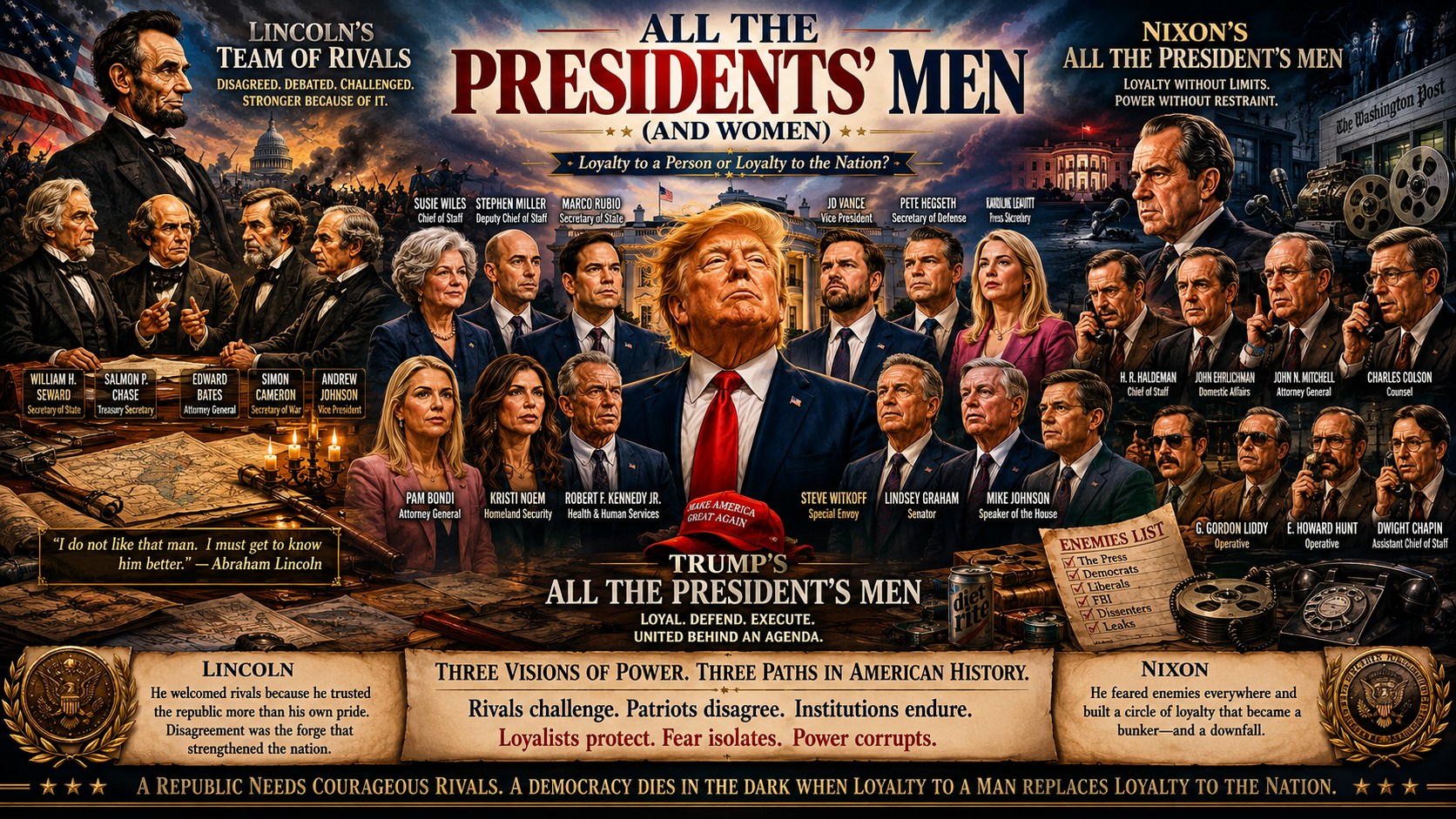
Doris Kearns Goodwin’s Team of Rivals captured one of the great paradoxes of American political leadership: Abraham Lincoln deliberately surrounded himself with men who doubted him, challenged him, competed against him, and in many cases believed they themselves should have been president.
His cabinet included towering political rivals such as William H. Seward, Salmon P. Chase, and Edward Bates, all former opponents for the Republican nomination in 1860. Lincoln governed during the gravest constitutional crisis in American history, with the Union literally disintegrating into civil war, yet he tolerated disagreement because he believed the presidency belonged not to his ego, but to the Constitution and the survival of the republic itself.
Lincoln’s cabinet room often resembled controlled intellectual warfare. Men argued fiercely over emancipation, military command, banking, wartime powers, reconstruction, and the future meaning of the Union. Rivalries simmered constantly. Ambition collided with moral catastrophe. Yet Lincoln absorbed disagreement rather than eliminating it.
Historians frequently note that Lincoln possessed enough confidence in his authority to permit dissent inside the room because he believed truth could emerge through conflict among capable people.
In Lincoln’s model, disagreement strengthened leadership.
The modern phrase “All the President’s Men,” however, carries a darker historical echo.
Long before it became shorthand for loyalists orbiting around Donald Trump, it became inseparable from Richard Nixon and the Watergate scandal, a presidency that evolved into a defensive fortress built increasingly around secrecy, suspicion, and personal loyalty.
As Nixon grew more distrustful of journalists, antiwar protesters, Democrats, federal agencies, intellectuals, and perceived enemies inside government itself, his inner circle narrowed and hardened. H. R. Haldeman became the rigid gatekeeper controlling access to the president. John Ehrlichman managed domestic political operations. John
N. Mitchell became deeply entangled in Watergate. Charles Colson embraced the role of political enforcer. Operatives such as G. Gordon Liddy and E. Howard Hunt pushed covert operations, surveillance, and political sabotage deeper into the machinery of government itself.
The tragedy of Nixon’s White House was not merely corruption but insulation. Loyalty became a closed circuit. Dissent diminished. Fear of enemies justified extraordinary behavior. The White House gradually transformed from a constitutional institution into something resembling a bunker where protecting the presidency increasingly meant protecting Nixon personally.
That historical shadow now hangs over modern discussions of Trump’s political orbit.
Figures such as Stephen Miller, Susie Wiles, Pete Hegseth, Marco Rubio, JD Vance, Karoline Leavitt, Pam Bondi, Kristi Noem, and Robert F. Kennedy Jr. are portrayed by
supporters as disciplined executors of an elected “America First” agenda. Critics, however, often frame them as modern presidential loyalists whose primary political function extends beyond governance into the personal defense of Trump himself.
That perception is shaped not only by policy alignment, but by highly visible acts of rhetorical and political protection.
JD Vance repeatedly defended Trump against criminal indictments and investigations, portraying prosecutions as politically motivated and framing criticism of Trump as attacks on the populist movement itself.
Stephen Miller has spent years publicly defending Trump’s immigration policies, executive authority, and nationalist agenda while portraying opposition from courts, bureaucracies, universities, and media organizations as resistance from entrenched elites hostile to democratic outcomes.
Karoline Leavitt often transforms press briefings into rapid-response defense operations against hostile media narratives, dismissing criticism of Trump as misinformation, bias, or coordinated political attacks.
Pete Hegseth has defended Trump’s nationalist rhetoric and military posture while framing critics inside media and government as disconnected elites hostile to patriotism and sovereignty.
Marco Rubio, once a fierce rival during the 2016 Republican primary, evolved into one of Trump’s most reliable diplomatic defenders, repeatedly arguing that establishment critics misunderstand the electorate that brought Trump to power.
Pam Bondi has publicly criticized investigations into Trump as selective or politically motivated, reinforcing perceptions among critics that legal and political defense increasingly overlap.
Kristi Noem rose nationally through fierce public defense of Trump-era immigration enforcement and confrontational populist messaging.
Robert F. Kennedy Jr. occupies a more unconventional role within Trump’s coalition, but his alignment with Trump on institutional distrust, especially toward public-health bureaucracies, pharmaceutical companies, and elite expert systems, reinforces the administration’s broader anti-establishment narrative.
Supporters argue these figures are defending a democratically elected presidency from hostile institutions seeking to undermine it. Critics argue the pattern reflects a political culture where loyalty to the leader increasingly outweighs institutional independence, expertise, or dissent.
The contrast among Lincoln, Nixon, and Trump reveals three profoundly different theories of political leadership.
Lincoln treated disagreement as a strategic asset.
Nixon increasingly treated disagreement as danger.
Trump’s movement often treats disagreement as sabotage by entrenched institutions hostile to populist democracy itself.
Lincoln’s cabinet resembled a constitutional war council: muddy boots, military maps, moral arguments about slavery and survival, rivals battling one another while the president absorbed contradiction in an attempt to preserve the Union.
Nixon’s White House resembled a fortress: tape recorders humming quietly, enemy lists, back-channel operations, trusted men whispering about leaks, revenge, and political survival.
Trump’s political world often resembles a permanent media battlefield: television cameras, social media warfare, branding, viral outrage cycles, rapid-response messaging,
and advisers functioning simultaneously as policymakers, ideological warriors, and public defenders of the leader himself.
Lincoln believed strong leaders tolerate criticism because criticism can strengthen the republic. Nixon increasingly feared criticism because he believed enemies surrounded the presidency. Trump’s supporters argue criticism itself has become weaponized through media, bureaucracy, academia, and elite institutions hostile to his movement. That creates the central democratic question running through all three presidencies…
What is the highest duty of advisers? To challenge the president when necessary? To defend the president at all costs? Or to defend the political movement the president represents?
Lincoln’s legacy suggests patriotism may require confronting power. Nixon’s downfall suggested excessive loyalty can isolate power from reality. Trump’s era raises a more modern question: in an age of permanent media war, populist polarization, and institutional distrust, can democratic systems still distinguish between loyalty to a nation, loyalty to a presidency, and loyalty to a political identity itself?
One model sees dissent as duty. Another sees dissent as danger. A third increasingly sees dissent as betrayal. And beneath all three lies the enduring American tension between republic and personality: whether power is ultimately restrained by institutions — or whether institutions gradually bend themselves around the force of a single leader.